
1. Design Goals
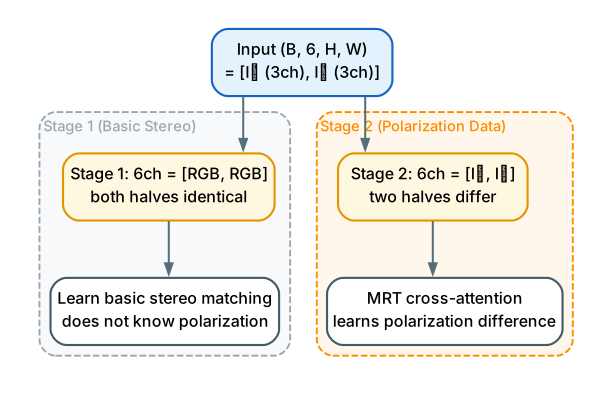
If a stereo matching architecture wants to use the polarization pair [I∥, I⊥], the most direct approach is to put the polarization pair into the input layer, without attaching a correction module or extra training stages outside the backbone. The 6-Channel Input architecture takes this most concise route: directly modify the Feature Pyramid’s input layer to 6 channels and feed both I∥ and I⊥ at once.
Design goals:
- No extra correction module is required.
- Polarization information is fused from the very first layer of feature extraction.
- The model decides on its own how to use the polarization information.
- The architecture is as concise as possible, with minimal changes to the original S2M2.
2. Architecture: 6-Channel Input
3. Components and Modules
Implementation file: s2m2_6ch.py
| Component | Responsibility |
|---|---|
CNNEncoder6ch | CNN encoder with conv0 modified to take a 6-channel input |
S2M2_6ch | S2M2 variant that uses CNNEncoder6ch |
load_pretrained_3ch() | Loads 3ch weights and expands them to 6ch (duplicate + /2) |
3.1 CNNEncoder6ch
CNNEncoder6ch changes the first convolution conv0 of the original CNNEncoder from a 3-channel input to a 6-channel input, so that the polarization pair [I∥, I⊥] is fused into feature extraction from the very first layer.
3.2 S2M2_6ch
S2M2_6ch is the S2M2 variant that uses CNNEncoder6ch. The subsequent components (Unet / MRT / DispInit / Refiner / Upsampling, etc.) are taken from the original S2M2 without modification.
3.3 load_pretrained_3ch()
load_pretrained_3ch() is used to expand the original 3-channel pretrained weights to 6 channels:
- Strategy: duplicate + /2 — copy the 3ch conv0 weights twice and concatenate them into 6ch, then divide the weights by 2.
- Rationale: duplicating and dividing by 2 makes the 6ch conv0 output equivalent to the original 3ch conv0 under a duplicated
[RGB, RGB]input, preserving pretrained properties as the training starting point.
4. 6ch Fixes Relative to the Original S2M2
When s2m2_6ch.py is refactored, the following two issues must be fixed relative to the original S2M2.
4.1 Fix 1: Transformer Call Convention
# Wrong: pass a list
self.transformer([left_py_4x, left_py_8x, ...], [right_py_4x, ...])

# Correct: concat in batch, then pass 4 pyramid levels
imgs = torch.cat([left, right], dim=0)  # batch concat
feature_tr_4x = self.transformer(feature_py_4x, feature_py_8x, feature_py_16x, feature_py_32x)
The Transformer does not accept a list. The left and right images should first be concatenated along the batch dimension, then the 4 pyramid levels (4x / 8x / 16x / 32x) should be passed in separately.
4.2 Fix 2: UpsampleMask1x Expects 3ch RGB
# Wrong: pass 6ch
filter_weights = self.upsample_mask_1x(disp_up, img0_nor, feature0_2x)

# Correct: pass only the first 3ch for edge detection
filter_weights = self.upsample_mask_1x(disp_up, img0_nor[:, :3], feature0_2x)
Design decision: edge-guided sharpening only needs the RGB of I∥; the polarization information is already inside the CNN features. UpsampleMask1x expects 3ch RGB for edge detection, so only the first 3 channels (I∥) are taken.
5. Tensor Dimensions
| Tensor | Shape | Description |
|---|---|---|
| 6ch input | (B, 6, H, W) | [I∥ (3ch), I⊥ (3ch)] |
| Stage 1 input | (B, 6, H, W) | [RGB, RGB]; the two halves are identical |
| Stage 2 input | (B, 6, H, W) | [I∥, I⊥]; the two halves differ |
| conv0 input (CNNEncoder6ch) | 6 channels | original was 3 channels |
| Transformer input | 4 pyramid levels | feature_py_4x / 8x / 16x / 32x; left and right concatenated along batch |
| Image input of upsample_mask_1x | img0_nor[:, :3] | only the first 3ch (I∥) for edge detection |
| pretrained 3ch conv0 weights | 3 channels | expanded to 6 channels via duplicate + /2 |
6. Polarization Injection Points
Injection point: the CNNEncoder input layer (injection point A).
The polarization pair [I∥, I⊥] is fused at the first convolution conv0 of CNNEncoder6ch, so polarization information is carried from the very start of feature extraction. Subsequently:
- MRT cross-attention naturally learns the polarization difference between the left and right halves.
- The model decides on its own how to use the polarization information; no extra correction module is needed.
7. Design Decisions and Rationale
| Decision | Rationale |
|---|---|
| Use 6-channel input | Most concise; no extra correction module; polarization is fused from the first layer |
Modify only conv0 (CNNEncoder6ch) | Minimal change; the subsequent Unet/MRT/Refiner are reused from the original |
load_pretrained_3ch uses duplicate + /2 | Equivalent to the original 3ch under a duplicated [RGB, RGB] input, preserving pretrained properties |
Stage 1 uses duplicated [RGB, RGB] input | The model first learns basic stereo matching; both halves are identical |
Stage 2 uses [I∥, I⊥] | The model sees two different halves for the first time; MRT cross-attention learns the polarization difference |
| Transformer changed to take 4 pyramid levels | The original Transformer does not accept a list; batch concat is required and levels must be passed in separately |
UpsampleMask1x only takes the first 3ch (I∥) | Edge-guided sharpening only needs I∥ RGB; the polarization information is already in the CNN features |
8. Highlights
- Most concise polarization injection: changing only the one layer
conv0is enough to fuse the polarization pair from the start of feature extraction; no correction module or extra training stage is needed. - Weight-equivalent pretrained transfer:
load_pretrained_3chuses duplicate + /2 so that under a duplicated[RGB, RGB]input the 6ch conv0 is equivalent to the original 3ch, enabling painless continuation of pretrained features. - Model decides how to use polarization: once polarization is fused from the first layer, MRT cross-attention naturally learns the difference between the left and right halves; no handcrafted usage is needed.
- Stage 1 and Stage 2 share the same input format: both stages use (B, 6, H, W); the only difference is whether the two halves are identical, allowing curriculum training to proceed seamlessly on the same architecture.