
1. Design Goals
When polarization participates in stereo matching, if the correlation volume is first fully computed and then corrected or modulated using pol information, there is a fundamental limitation: once a wrong correlation has been formed, correcting it is too late.
If the correlation value of a false match is already high at the computation stage, post-hoc additive residuals, gating, and modulation can only try to suppress it, but cannot prevent it from being computed in the first place.
The design goal of this architecture is: move the intervention point from “after corr computation” to “during corr computation” — let polarization participate at the moment correlation is formed, suppressing false matches at the source.
| Post-Corr approach | Pre-Corr Weighting (this architecture) | |
|---|---|---|
| Timing | After corr computation | During corr computation |
| Effect | Correct existing corr | Influence the formation of corr |
| Analogy | After-the-fact remedy | Source intervention |
2. Architecture Design: Pre-Corr Pol Weighting
# Pre-Corr (pol participates in corr computation)
for d in disparity_range:
    pol_diff_d = left - shift(right, d)
    pol_weight_d = sigmoid(f(pol_diff_d))  # [0, 1]

    # pol directly affects the weight of correlation
    corr[d] = dot(fmap1, fmap2_at_d) * pol_weight_d
This architecture does not “first compute the full corr and then correct it”; instead, at the moment correlation is computed per disparity, it multiplies by a weight pol_weight_d determined by pol.
- For each disparity candidate
d: first compute the polarization differencepol_diff_d = left - shift(right, d)at that d. - Use a small function
fplus sigmoid to convertpol_diff_dinto a [0,1] weightpol_weight_d. - Correlation is weighted at computation time:
corr[d] = dot(fmap1, fmap2_at_d) * pol_weight_d.
Physical Meaning
- High
pol_weight_d: thepol_diffat this disparity matches the characteristics of “the same physical point”, so this match is trustworthy. - Low
pol_weight_d: this disparity may be a false match (reflection / misalignment), and this match should be suppressed. - False matches are suppressed at the moment correlation is formed, rather than corrected afterwards — false matches cannot obtain high correlation values from the start.
3. Architecture (Data Flow)
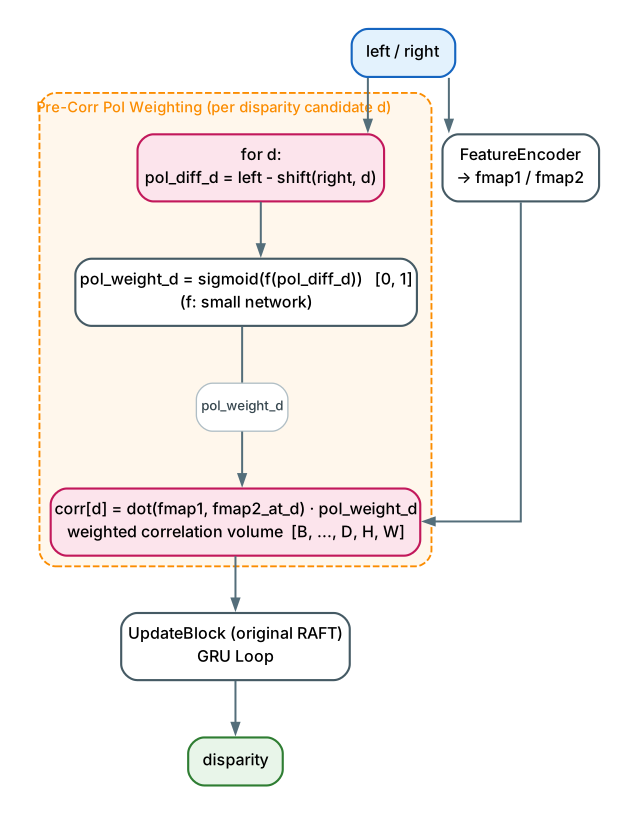
The key point is that * pol_weight_d occurs in the same step where corr[d] is written, rather than as a separate modulation after the full corr is formed.
4. Components and Modules
| Component | Function |
|---|---|
Pol Weighting function f + sigmoid | Produces pol_weight_d in [0,1] from pol_diff_d; hidden dimension configured by pol_weight_hidden (e.g. 8) |
| Weighted Correlation computation | Multiplies by pol_weight_d while computing correlation per disparity |
| UpdateBlock | Reuses the original RAFT |
f is a small network (pol_weight_hidden=8), deliberately kept lightweight, positioned as mechanism validation rather than a black box.
5. Tensor Dimensions
| Tensor | Shape | Description |
|---|---|---|
fmap1 / fmap2 | FeatureEncoder output | Used to compute correlation |
pol_diff_d | (B, *, H, W) | Polarization difference at the d-th disparity |
pol_weight_d | (B, 1, H, W) | [0,1], per-disparity weight |
corr[d] | (B, *, H, W) | Weighted correlation at the d-th disparity |
| Correlation volume | (B, ..., D, H, W) | Stack over all d |
6. Hyperparameters
| Hyperparameter | Value | Description |
|---|---|---|
pol_weight_hidden | 8 | Hidden dimension of the Pol Weighting function f |
pol_levels | 4 | Number of pyramid levels in the polarization volume |
pol_radius | 4 | Lookup radius of the polarization volume |
iters | 24 | Number of GRU iterations |
7. Design Decisions and Rationale
| Decision | Rationale |
|---|---|
| Place the intervention point at pre-corr (during correlation computation) | Suppress false matches at the moment correlation is formed, avoiding “the error has been made, correction is too late” |
Compute pol_weight_d per disparity | The weight carries disparity semantics, enabling separate trustworthiness judgement for each candidate |
Use dot(...) * pol_weight_d multiplicative weighting | Directly scales correlation strength; false matches cannot obtain high scores at the source |
f uses a small network (hidden=8) | Mechanism proof — validates the pre-corr weighting mechanism itself |
| Sigmoid output in [0,1] | The weight cannot amplify correlation, only “preserve or suppress” |
| UpdateBlock keeps the original RAFT | Preserves pretrained capability |
8. Highlights
- Places the polarization intervention point at the “moment of computing” correlation rather than “after computing”, suppressing false matches at the source and avoiding the difficulty of correcting wrong correlations once they are formed.
* pol_weight_dand the writing ofcorr[d]happen in the same step; polarization directly participates in the formation of correlation rather than being added as an extra modulation layer.- The polarization weight is computed per disparity, carrying disparity semantics, enabling separate trustworthiness judgement for each candidate.
- The sigmoid output in [0,1] can only “preserve or suppress” correlation and cannot amplify it, so false matches cannot obtain high scores at the source.
- The Pol Weighting function
fis deliberately kept as a small network (hidden=8), positioned as mechanism validation; UpdateBlock reuses the original RAFT, preserving pretrained capability.